Genuine Smeg parts
Brand-approved heating elements, thermostats, and boards fitted correctly, rather than a generic part that fails again in a few months.

Home / Blog / Smeg Oven Not Working
SMEG OVEN REPAIR · JOHANNESBURG & CENTURION
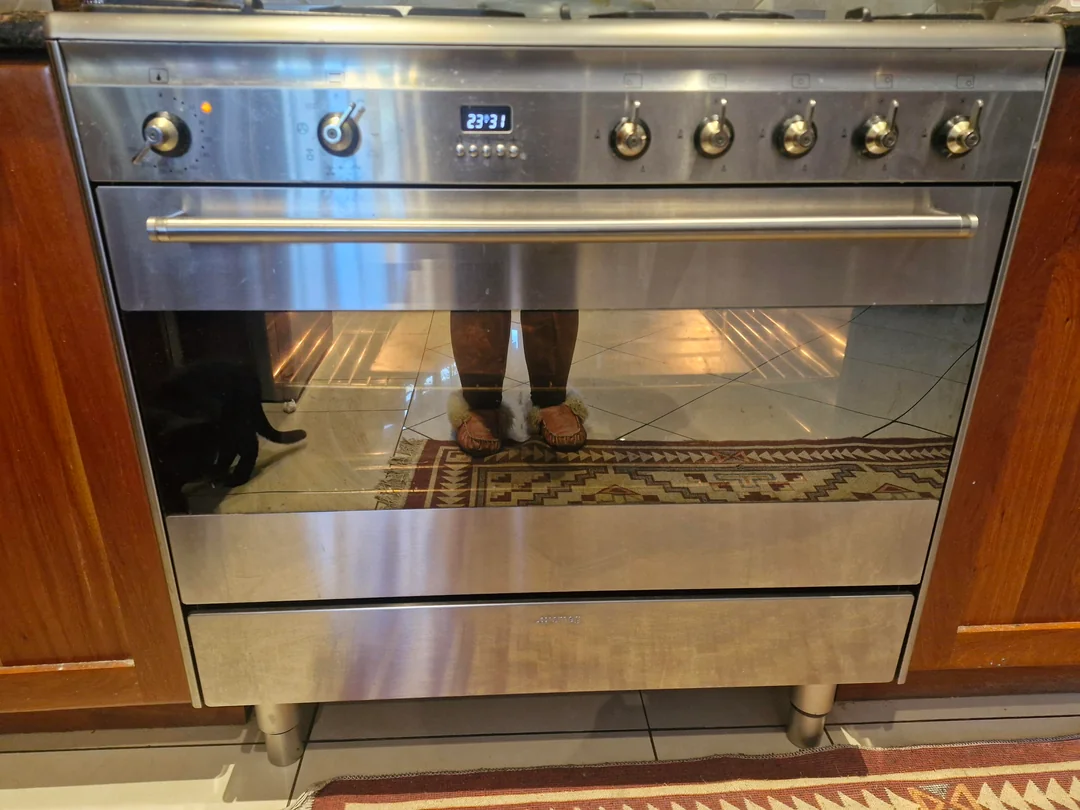
A Smeg oven that won't heat, throws an error code, or has a door that won't latch is almost always one of a handful of faults — and most can be diagnosed on the first visit. Here's how to tell what's wrong before you book a repair.
Failed heating element, faulty thermostat, or a tripped thermal fuse.
Usually points to a sensor, control board, or door lock fault — the code narrows it down fast.
Worn door seal, misaligned hinge, or a faulty door lock switch.
Often a fan motor issue, or a heating element only working on one side.
Blown bulb, faulty wiring, or a control board no longer powering that circuit.
WHY IT'S WORTH CALLING SOMEONE
Smeg's multifunction ovens rely on precise sensors and control boards to manage temperature, fan speed, and cooking programmes. A single faulty sensor can throw symptoms that look unrelated — like an oven that powers on but won't hold temperature. Guessing at a fix can mask the real fault, or damage a board that was otherwise fine.
Power cuts and surges are hard on control boards and door-lock solenoids. If your oven started throwing errors after a bout of load-shedding, that's often not a coincidence — and it's worth mentioning to your technician.
WHAT WE GET CALLED OUT FOR MOST
If you're seeing any of these, it's worth booking a technician before the fault spreads to another part.
Check the breaker first — if that's fine, it's usually a failed heating element, a faulty thermostat, or a tripped thermal fuse cutting power to the element.
Smeg ovens are good at telling you what's wrong — the code usually points straight to a sensor, control board, or door lock fault, which speeds up the diagnosis.
A perished door seal lets heat escape and throws off cooking times; a misaligned hinge or worn latch stops the door closing flush at all.
Usually a fan motor that's slowing down, or one of two heating elements no longer firing — both cause hot and cold spots in the cavity.
A blown bulb is the simple case; if the display itself is blank, it's more likely a wiring fault or a control board no longer powering that circuit.
A 5-MINUTE CHECK
These checks rule out the simplest causes. If the fault's still there afterwards, it's a job for a technician.
Confirm the oven is firmly plugged in (or wired in, for built-in models) and that the relevant breaker hasn't tripped.
If the display is showing a code, write it down before you call — it lets the technician arrive with the likely part already in hand.
Run a finger around the rubber gasket for tears, flattening, or gaps — a damaged seal is a common, inexpensive fix.
Switch off at the breaker for two minutes, then switch back on. It won't fix a hardware fault, but it does clear the occasional software glitch.
WORKING WITH A CERTIFIED TECHNICIAN
Brand-approved heating elements, thermostats, and boards fitted correctly, rather than a generic part that fails again in a few months.
Parts and labour are covered, so if the same fault returns, you're not paying for it twice.
Oven elements and control boards run on mains power — a technician knows how to isolate and test them safely.
You'll be told plainly whether it's worth repairing or whether replacement makes more financial sense.
PRICING
The honest answer is "it depends on the fault" — but here's the shape of it, so you're not going in blind.
Covers the technician's visit and a full diagnosis, credited toward the repair if you go ahead.
Door seals, thermostats, bulbs, and hinge adjustments typically fall in this range.
Major component replacements — a control board, heating element, or fan motor — cost more, but you'll always get a written quote before any work begins. No surprises on the invoice.
MAINTENANCE
Built-up grease and food residue on the element and cavity walls makes the oven work harder and can shorten element life.
A quick visual check catches a perishing gasket before it starts costing you in escaped heat and longer cook times.
Repeated slamming is one of the most common causes of hinge and latch wear on built-in ovens.
Foil can block airflow and reflect heat onto the element, shortening its lifespan over time.
WHO TO CALL
WHERE WE WORK
We send technicians who know the area, the housing stock, and the appliances — not a dispatcher reading from a script.
Send a technician a WhatsApp message with the fault (or error code) and your suburb, or call directly — most call-outs in Johannesburg and Centurion are handled the same day.